
Why people stick to plans the facts no longer support
Some of the most expensive failures in business do not happen because nobody saw them coming.
They happen after the problem is visible.
The deadline no longer fits. The team is exhausted. The investment has not worked. The customer relationship is deteriorating. Everyone can repeat the facts, yet the forecast remains, the project continues and resources are committed as if the hoped-for version of events were still real.
This is where an early, manageable loss becomes a late crisis. A deadline that could have been renegotiated becomes a failed launch. A difficult customer conversation becomes an angry call at two in the morning. A capacity problem becomes burnout, poor work and resignations.
The important question for a leader is therefore not only whether the organisation has the facts. It is whether those facts have enough authority to change what the organisation does.
I recently saw a stripped-down version of this problem while watching a group of capable executives work through the same assessment exercise.
The situation was deliberately uncomfortable. An established operation was deteriorating. A new operation was due to open. The same experienced team was needed for both, and that team was already tired. The dates and resource requirements were in the brief.
Even under generous assumptions, both commitments could not be met as planned.
Most of the candidates could see the individual facts. They repeated them accurately. Then they produced plans in which those facts somehow stopped applying. The team was split. The work was compressed. People and time became elastic. Both clients would be protected and the original deadline would survive.
I need to be fair about this. I wrote the exercise and knew its arithmetic. Hindsight gave me a clarity the candidates did not have. A small assessment group is not scientific evidence of a universal human tendency.
But I recognised the pattern because I see it elsewhere. In businesses. In projects. In personal decisions. People can describe a situation accurately and still make a decision that depends on the situation being different.
The facts were intellectually understood. They were not allowed to govern the decision.
That is a more consequential problem than simply not knowing.
Facts do not make decisions
We often respond to a poor decision by supplying more information. Sometimes that is exactly what is needed. The person did not know, the data was weak or the situation had changed.
But facts do not choose between competing goods. They do not decide which customer to disappoint, which project to delay or who must carry the loss. They can show that the current promise is no longer credible. They cannot make accepting that conclusion painless.
In the assessment exercise, the difficult fact was not really the timetable. It was what the timetable required someone to say:
We cannot deliver everything we promised. One of these outcomes has already been lost.
The facts did not create that loss. They revealed it. The implausible plan offered a way to postpone owning it.
There is no single psychological label for what happens next, but the research gives us several useful parts of the explanation.
We reason towards the answer we can live with
Research on motivated reasoning does not say that people simply believe whatever they want. It shows something more subtle. Preferences can affect which evidence we collect, how we test an argument and which memories or explanations come most readily to mind. The conclusion still feels reasoned because reasoning genuinely took place. It just did not treat every conclusion equally.
This matters when the unwelcome conclusion threatens something important: a commitment, a relationship, a reputation or a view of ourselves.
“The deadline must move” is not merely a scheduling judgement if I see myself as the person who always delivers. “This investment will not work” is not merely a financial judgement if I sponsored it. “This relationship is over” is not merely an assessment of evidence if accepting it changes the future I have been living towards.
The mind does not have to invent new facts. It can preserve the preferred conclusion simply by demanding more proof from bad news, finding one more optimistic interpretation or treating a hope as if it were an assumption.
That is why intelligent people are not protected from this. Intelligence can help us test a belief. It can also help us build a better defence of the belief we need to keep.
A gamble can feel better than a certain loss
Kahneman and Tversky’s prospect theory found that people’s appetite for risk changes depending on whether a choice is experienced as a gain or a loss. Faced with a sure loss, people can become willing to accept a risky alternative that preserves some chance of escaping it.
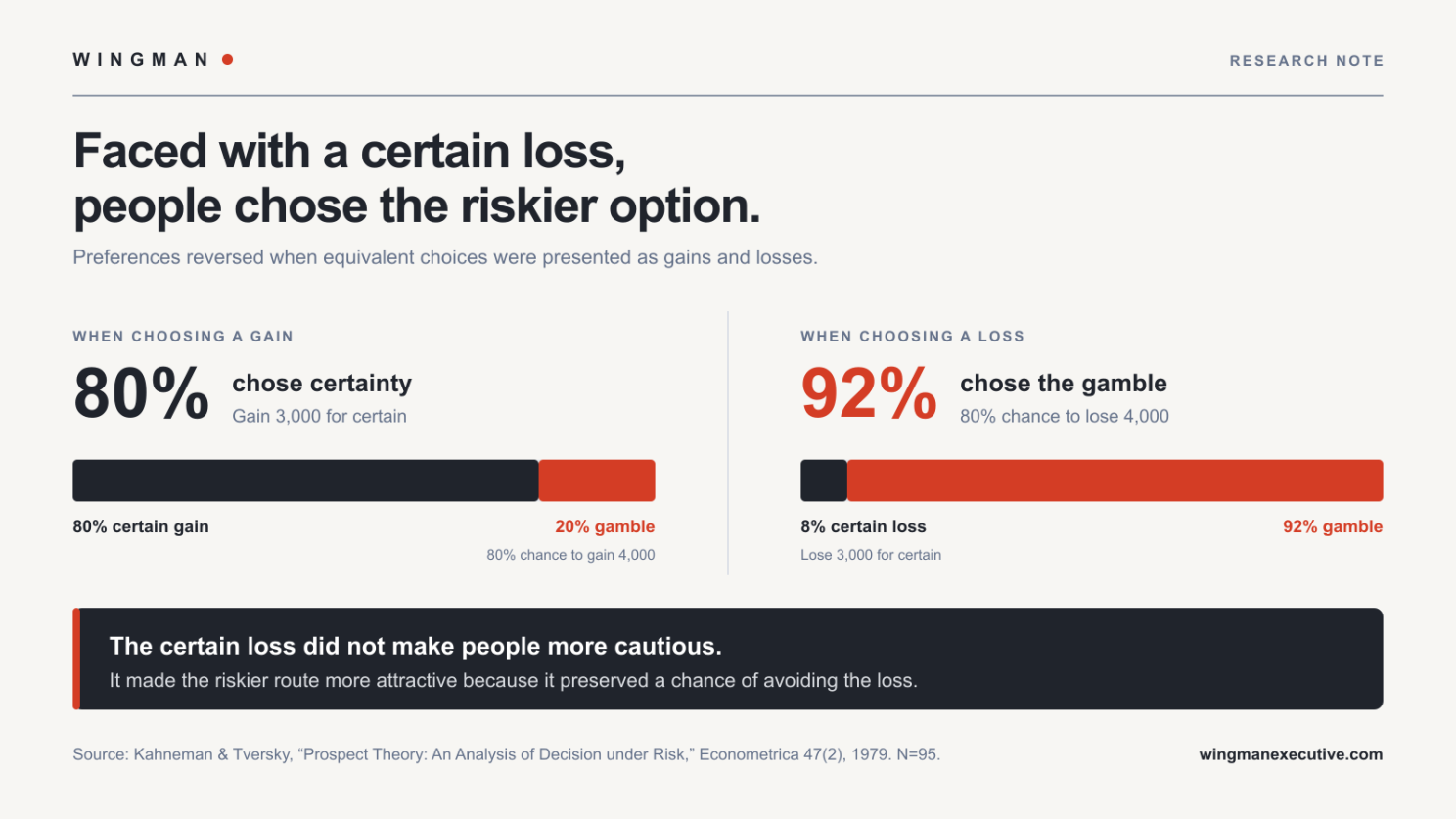
That maps closely onto the assessment problem.
Accepting a delay made the loss visible and certain. Splitting the team created a fragile but emotionally attractive possibility that both outcomes might still be saved. It converted “we will miss a commitment” into “we might pull this off.”
The second sentence feels more like leadership. It sounds energetic. It keeps hope alive. It may even be praised as ambition.
But hope is not capacity, and effort does not alter arithmetic.
This is where performance pressure matters. Targets are useful, but they can narrow attention towards the measured outcome and away from the conditions that make it achievable. If success means hitting the date, admitting that the date has already gone can feel like failure. A plan that keeps the target alive becomes attractive before anyone has established whether it can work.
People learn which truths are safe to act upon
The problem is not only inside the decision-maker.
In organisations, bad news has a social cost. The person who says the plan will not work may be treated as negative, insufficiently committed or responsible for fixing it. The person who promises recovery may look decisive—at least until reality arrives.
Research on employee voice and silence shows that whether people raise concerns depends partly on the risks and consequences they expect from speaking. Amy Edmondson’s work on psychological safety similarly connects a team’s willingness to take interpersonal risks with the behaviours required for learning.
This creates a problem for leaders. You may believe you have asked for the truth. Your team may have learnt that what you really reward is reassurance.
If the person who names an emerging loss gets blamed for it, you will not get early warning. You will get late optimism.
By the time reality settles the argument, the useful options have usually narrowed. The business still has to accept the loss it was avoiding, but now it must do so with less time, more money committed and more people exposed.
Knowing still has to become doing
There is also a less dramatic explanation. Sometimes people genuinely accept a fact but do not convert it into action.
The gap between intention and behaviour is well established. A large meta-analysis of implementation intentions found that specifying when, where and how an action will happen improved goal attainment. Agreement alone is weak. Action becomes more likely when a trigger and response are made explicit.
In a business decision, “we need to be realistic about the deadline” is not yet a decision.
Who will change it? By when? Which work stops? What do we tell the customer? What evidence would allow us to retain the date? At what point do we stop hoping and reconfigure the plan?
Until those questions are answered, people can sincerely agree with the facts while continuing to behave as if nothing has changed.
Realism is not surrender
I have seen the opposite done well.
During a large operational transformation, newly trained teams were beginning to use passenger-loading bridges around aircraft. We knew there was a transition risk. We did not cancel the change because an incident was possible, and we did not pretend the transition would be flawless.
We put the risk in front of the client. We briefed it. Senior leaders were visible during the transition. The teams were supported, and everyone understood what we would do if the known risk materialised.
That is not pessimism. It is not an absence of ambition. The change continued because the risk had been accepted and the response designed before reality tested the plan.
False optimism says everything will be all right.
Sound judgement says: this is what might not be all right, this is what we are doing about it, and this is what we will do next if it happens.
What to do when the plan refuses to move
When I think a person or a team is acknowledging reality without acting on it, I now want to ask five questions.
1. What do we know, what are we assuming and what are we merely hoping? The categories must remain separate. A plan cannot borrow certainty from a hope.
2. What loss are we avoiding making explicit? Which deadline, promise, investment or identity is already threatened? Naming the loss often explains the contortions around the evidence.
3. What would have to change if we truly accepted this fact? Look for a change in resources, sequence, ownership, scope or commitment. If the plan remains identical, the fact has not yet governed the decision.
4. What is the trigger for changing course? State the condition and the action in advance: if this is not true by this date, we will do that. Do not wait until the same argument has to be won again under greater pressure.
5. What happens to the person who brings the bad news? If the honest answer is blame, loss of status or ownership of an impossible recovery, the organisation is producing the optimism it claims to dislike.
One principle sits underneath all five.
A plan has to be comfortably achievable on paper if it is to have a serious chance in the real world. If it only just works at one-G, in clear conditions and with a cup of coffee, reality will break it.
Accepting reality early can feel like giving up. Usually it is the point at which useful agency returns. The delay can be managed. The scope can be changed. The customer can be told. Resources can be moved. Another route can be built.
Until then, effort is being spent defending a future that the available facts no longer support.
A fact has not been accepted because it appears in the report or can be repeated in the meeting. It has been accepted when the plan changes.
Sources
- [Nicholas Epley and Thomas Gilovich, “The Mechanics of Motivated Reasoning,” Journal of Economic Perspectives (2016)](https://www.aeaweb.org/articles?id=10.1257/jep.30.3.133)
- [Daniel Kahneman and Amos Tversky, “Prospect Theory: An Analysis of Decision under Risk,” Econometrica (1979)](https://web.mit.edu/curhan/www/docs/Articles/15341_Readings/Behavioral_Decision_Theory/Kahneman_Tversky_1979_Prospect_theory.pdf)
- [Elizabeth W. Morrison, “Employee Voice and Silence,” Annual Review of Organizational Psychology and Organizational Behavior (2014)](https://www.annualreviews.org/content/journals/10.1146/annurev-orgpsych-031413-091328)
- [Amy C. Edmondson, “Psychological Safety and Learning Behavior in Work Teams,” Administrative Science Quarterly (1999)](https://doi.org/10.2307/2666999)
- [Peter M. Gollwitzer and Paschal Sheeran, “Implementation Intentions and Goal Achievement,” Advances in Experimental Social Psychology (2006)](https://doi.org/10.1016/S0065-2601%2806%2938002-1)
First published on LinkedIn on 11 September 2026. Read the original article.