What One Client Learned After Losing Two Managers
A client told me recently that they had been struggling; decisions were slow, execution was all over the place, and they kept getting the sense that what they said at the top wasn't what people heard at the bottom.
Then, for various reason, two of her managers left the business.
What followed wasn't chaos. It was the opposite.
They started speaking directly with those managers' former team members. The information got sharper. More honest. More useful. Decisions sped up. Execution improved. Not perfect—but clearly better than before.
Nothing magical changed in the operation. The only real change was this: they removed a management layer that had been getting in the way of the truth.
Now, I'm not saying the answer is to fire your managers. That's not the point. The point is what this revealed: the problem wasn't the front line. It wasn't the strategy. It was the information flow—and the people controlling it.
This article is about that distortion. How to spot it. And how to fix it.
Leaders Don't Need More Data. They Need Decision-Quality Information.
Here's the thing. As you move up, your job changes. You stop doing the work and start deciding what work should be done, in what order, and at what risk. Your value now depends on the quality of information you get.
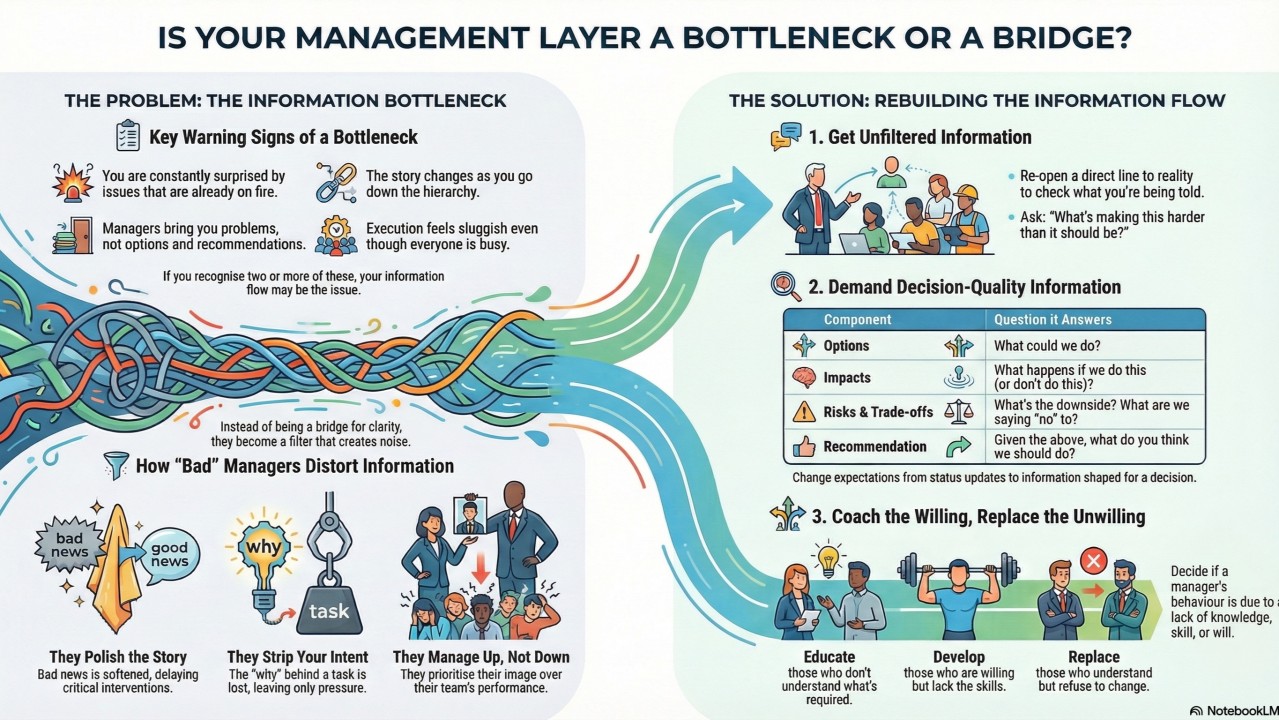
I call this decision-quality information. It's not more slides, dashboards, or RAG statuses. It's information that's actually shaped for a decision:
- Options – What could we do?
- Impacts – What happens if we do it or don't do it?
- Risks – What's the downside and how bad is it if it happens?
- Trade-offs – If we say yes to this, what are we saying no to?
- Recommendation – Given all that, what do you think we should do?
In military aviation - which is where I spent a good chunk of my career - you don't get to hide behind "we can't." The expectation is clear: your job is to provide options and risks, there is always a way.
That mindset applies just as much in business. Leaders don't need comfort. They need clarity.
How Management Goes Bad
Middle managers should be incredibly valuable. When it works, they translate your intent into clear direction, support their teams, and bring you decision-quality information.
But when it goes wrong, they become filters and bottlenecks instead of bridges. And that's exactly what my client ran into.
They polish the story. Bad managers learn quickly what senior leaders want to hear. So instead of "we're three weeks behind and don't understand the new system," you get "we're mostly on track—just a few minor delays." By the time the truth comes out, your options are limited and fixing it costs more.
They strip out your intent. The client put it like this: "I would give a clear why and what. By the time it reached the team, it had turned into pressure and noise." The leader's intent—fix the system—got translated into pressure: go faster. Direction without context just became noise.
They become the bottleneck. Everything has to go through them. Every decision. Every exception. Every update. Teams stop thinking and start waiting. You see this in calendars full of status meetings, approvals, and "just checking" calls. The manager isn't adding value—they're slowing everything down.
They manage up, not down. They're more worried about how they look than how the team is doing. Problems get played down. Friction gets hidden. Conflicts get smoothed over instead of surfaced. Senior leaders end up with a version of reality that's been cleaned up for them.
They kill initiative. The message—whether it's said out loud or not—is "just do what you're told." And then leadership wonders why no one shows initiative, why nobody thinks like an owner. The thing is, those same people are running families, side hustles, and community groups with real responsibility and judgment. They're capable. They're just not being led that way.
How to Spot If Your Management Layer Is the Problem
If you're a senior leader, here are some warning signs.
You're constantly surprised by what's actually going on. Issues reach you late and already on fire.
The story changes as you go down the hierarchy. What you said, what managers repeat, and what teams hear are three different things.
Managers bring you problems, not options. Lots of "we can't" and very little "here's what it would take."
Front-line conversations are sharper than management updates. When you walk the floor, you get a clearer picture than you do in the formal review.
Execution feels sluggish, even though everyone is very busy.
If you recognise two or more of these, the problem isn't your strategy. It's your information flow—and the managers controlling it.
Fixing It
So what do you do? Here's how you can start to turn this around—without immediately reaching for the eject handle.
Re-open a direct line to reality. You don't need to bypass your managers permanently, but you do need unfiltered contact with the work. Skip-level conversations. Walking around—not theatre, not inspection. Just genuine curiosity. How's everything going? What's making this harder than it should be? Anything I can do to help?
You're not there to solve everything on the spot. You're there to check whether what you hear matches what you're being told. That's exactly what my client found: when they started talking directly to the people doing the work, the picture changed.
Redefine what you expect from managers. Most organisations quietly reward managers for keeping noise away from the top. Change that. Their job is to set direction, provide support, and take accountability. And to bring you decision-quality information—not just status updates.
Make it clear what a good escalation looks like: here are the options, here's the impact of each, here are the risks and trade-offs, here's my recommendation.
Train them to think in "yes, and here's what it would mean." Ban pure no. When managers say "we can't do that," coach them to reframe it. Yes, we can—but it would push Project X by two weeks. Yes, we can—but we'd need more budget. Yes, we can—but here's the added risk.
This forces real thinking about trade-offs. It gives you the information you need to decide. And it builds a culture where constraints get surfaced, not hidden.
Decide: coach or replace. Not every bad management behaviour is malicious. Often it's one of three things. They don't get it—nobody has ever actually taught them what good leadership looks like. They can't do it yet—they're willing but don't have the skills. Or they won't do it—they understand but refuse to change.
Your actions follow from there. Educate the first group. Develop the second. And the third? Decide quickly. You can't build a culture of truth and accountability on top of people who are actively resisting both.
In my client's case, things got noticeably better when those two managers left. That wasn't the goal. But it was what happened. Sometimes the fastest way to improve information flow is to remove the person blocking it.
The Long Game
The goal isn't you talking to everyone directly forever. In a mature organisation, authority sits where the information is. Teams closest to the work make more of the decisions. Managers focus on setting intent and enabling, not controlling.
You get there by sharing clear intent—why, what matters most, what success looks like. You expect managers to use that intent to guide decisions, not just pass on orders. And you gradually increase the level of decision they can make without checking in, based on how good their judgment is.
Bringing It Home
My client didn't set out to prove that their managers were the problem. They stumbled into it. But what they learned was clear: their decisions had only ever been as good as the information reaching them. And for too long, that information had been bent, delayed, and cleaned up until it wasn't much use.
If you've ever thought "why don't they just think?" or "why does everything get lost in translation?" or "why am I always the last to know?"—there's a good chance your issue isn't the front line. It's the layer in between.
If you want a simple starting point this week, try this. Pick one manager and one team. Have a skip-level conversation. Compare what you hear with what you've been told.
If there's a gap, don't start by blaming them. Start by fixing the system you've allowed to grow.